
How to Read Architectural Plans: A Beginner-Friendly Guide
- Anja Kodrič
- May 8
- 2 min read
Understanding architectural plans is one of the most important skills when designing or building a tiny house. Although they may look complex at first, once you learn the basics, the logic behind floor plans, symbols, and spatial relationships becomes clear. This beginner's guide will help you learn how to read architectural plans for a tiny house with confidence and clarity.
Basic Elements of Architectural Plans

When learning to read architectural plans for a tiny house, the first step is to understand the core elements: floor plans, elevations, sections, and details. The floor plan shows the layout from above, elevations reveal the exterior appearance, and sections illustrate heights, levels, and construction. When you combine these three, you get a complete understanding of the space.
How to Understand Spatial Logic
In tiny houses, spatial logic is everything. When learning how to read architectural plans for a tiny house, you’re not just looking at what is drawn — you’re understanding why it is placed there. You read the flow of movement, natural light, proportions, heights, and functional axes. A good floor plan reveals how the space breathes, how it’s used, and how it feels when you move through it.
Dimensions and Sections
Dimensions define the exact size of walls, openings, and built‑ins, usually in millimeters or centimeters. Accurate dimensions are essential for tiny house interior layouts, where precise measurements ensure that every element aligns perfectly and no space is wasted.
Sections illustrate how spaces connect vertically, revealing heights, structural layers, and multi‑level transitions. They are crucial in tiny house loft design, compact vertical circulation planning, and multi‑level tiny home layouts, where lofts, raised platforms, hidden storage zones, and under‑floor compartments create additional usable volume.

Key Symbols You Must Understand
Architectural plans use standardized symbols for windows, doors, stairs, utilities, and furniture. Knowing these symbols is essential because they allow you to interpret how the space functions. Here are the symbols you’ll encounter most often:
Door symbols — reveal how the door moves and how much clearance it requires. In tiny houses, this symbol is essential for understanding circulation and avoiding conflicts with furniture or built‑ins.

Window symbols — help you read daylight entry, ventilation potential, and the overall rhythm of the façade in a compact layout.

Electrical outlets — marked with small circles, letters, or paired dots, showing where appliances can be plugged in. In tiny homes, outlet placement is highly strategic because every zone often serves multiple functions.

Lighting symbols — reveal the lighting strategy of the space, which is essential in tiny houses where light defines the perception of spaciousness.

Kitchen symbols — show the functional flow of the kitchen, the distances between elements, and the logic of food preparation within a compact layout.
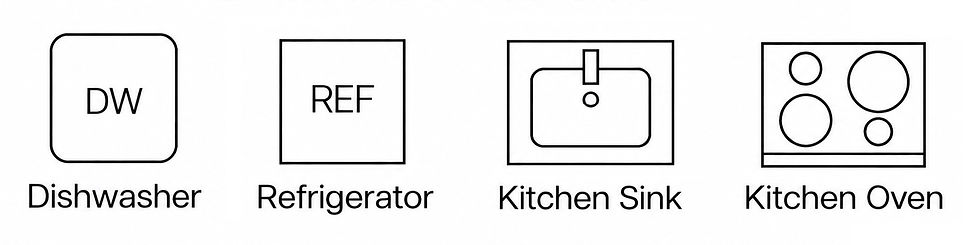
Bathroom symbols — help you understand ergonomics and the minimum required clearances, which are crucial for comfortable use in tiny house bathrooms.

HVAC symbols — illustrate how air moves through the space, directly influencing the energy efficiency of small homes.
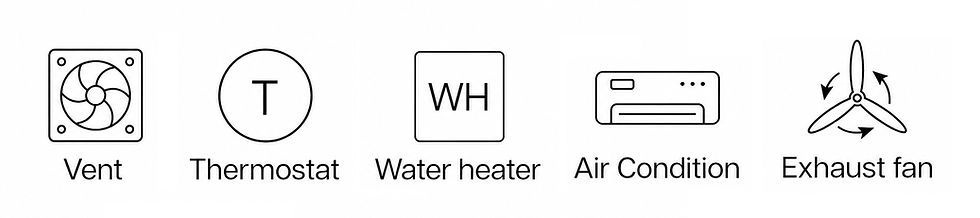
Stairs symbols — represented as a sequence of steps with an arrow indicating the direction of ascent. These symbols reveal the vertical connection between levels and help you assess how much floor area the staircase actually occupies.


